Demo
Abstract
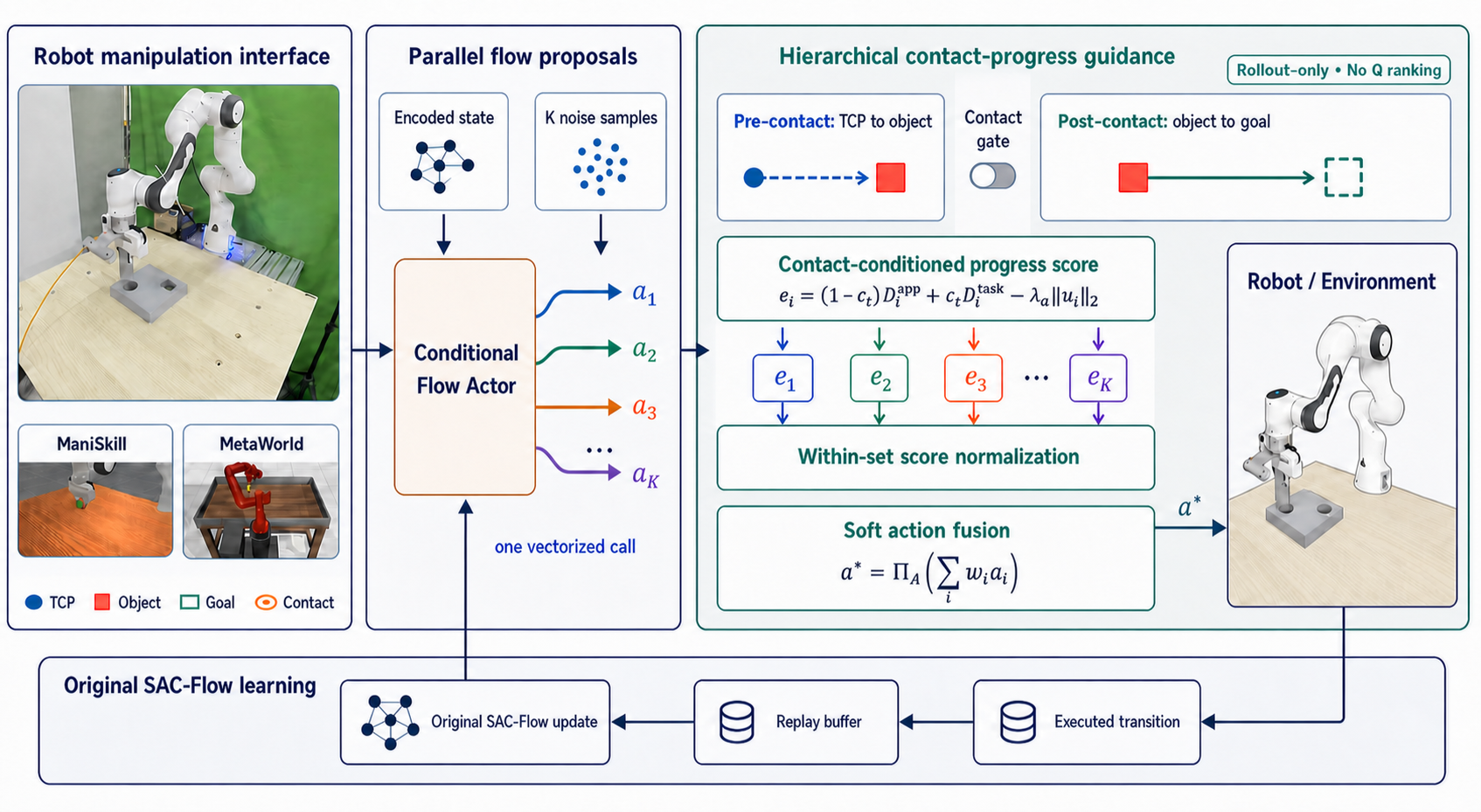
Flow policies can represent multimodal action distributions for robot manipulation, yet a robot must execute one action at each control step. HCPG-Flow augments SAC-Flow with an analytic, object-centric selector: before contact it favors tool-to-object progress, while after contact it favors object motion along a task-relevant direction. Proposal scores are normalized within the candidate set and converted into a temperature-controlled soft action. The selector introduces no learned parameters or auxiliary backward pass and leaves the original SAC-Flow actor and critic objectives unchanged.
Method
Results
Across-task last-five success improves from 87.2% to 96.7% on ManiSkill and from 94.7% to 97.1% on MetaWorld. Across four physical tasks, HCPG improves pooled success from 91.7% to 98.3% and reduces the macro-average steps to first success from 62.4 to 51.6 (17.4% fewer) relative to SAC-Flow.
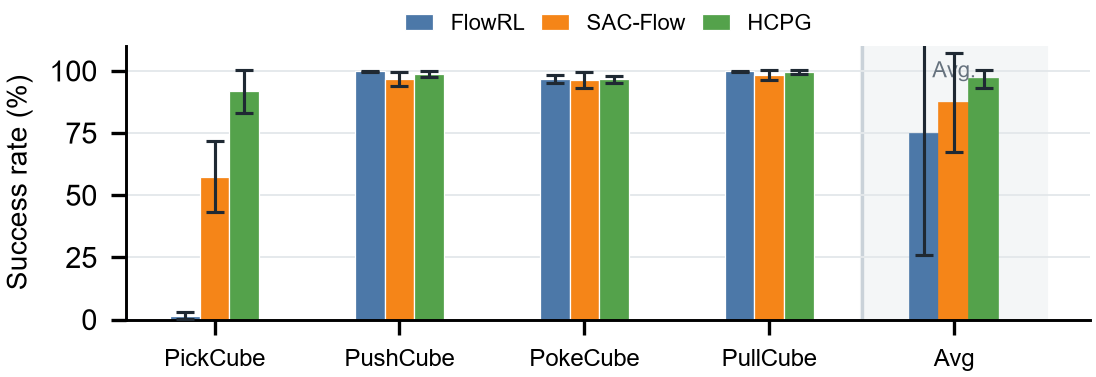
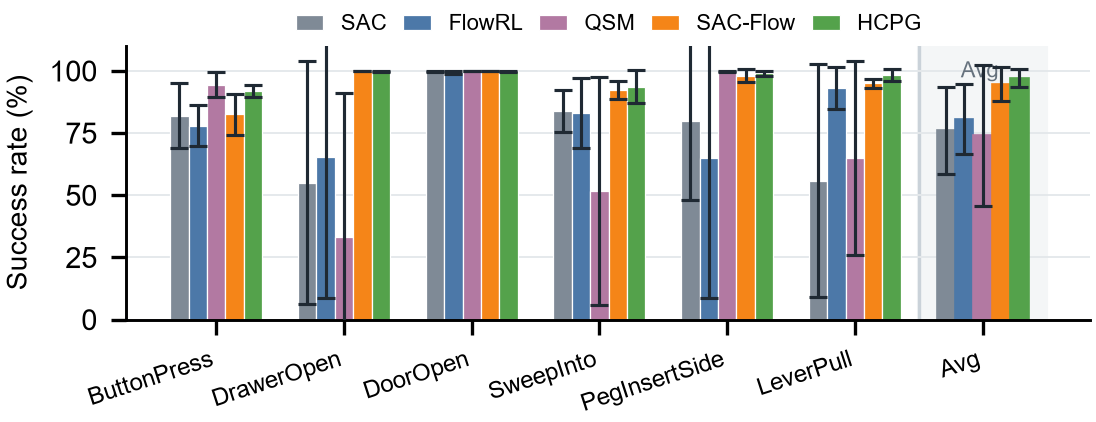
Bars show means; error bars denote standard deviation. They are not confidence intervals or bounded success-rate ranges.